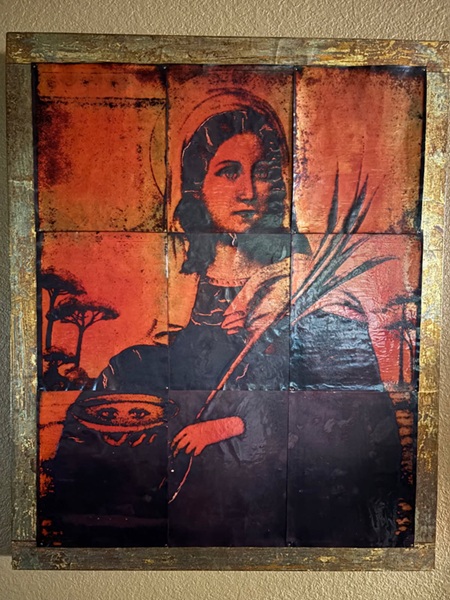
I’m sitting in a huge Catholic church in New York City, fidgeting next to my mother. I’m a 10-year-old tennis player, staring up at a statue. “Mom, why is that Saint holding two tennis balls?” I whisper. “Those aren’t tennis balls Stephen; those are her eyes.” “That’s St. Lucy, she’s the patron saint of vision.” Fast forward nearly 40 years and I had almost forgotten this until one morning walking into my laser suite. This little lady from Santa Fe stopped me, looked me directly in the eyes and slipped a tiny figure into my hand, “Do a good job young man” she said to me. “I prayed for you last night, and I prayed to St. Lucy too.” I still have that statue on my laser today.
The story of Saint Lucy is not actually from the Bible. It comes instead from early Christian tradition and historical accounts of Christian martyrs that date back to the 4th century AD.
Lucy was a young Christian woman, an early convert to Christianity, from Sicily an island about 2 miles off the coast of Italy. Her mother had arranged for her to marry a young, wealthy man who was non-Christian. Lucy persuaded her mother to visit the shrine of Saint Agatha, another Christian martyr, hoping that her mother's illness would be cured.
After being healed, her mother agreed to abandon the wedding plans and to give her dowry to the poor. Understandably angered, by this, her prospective bridegroom reported Lucy to the Roman authorities who tortured and killed her. As part of her martyrdom, the persecutors gauged out her eyes but her vision was later restored.
Lucy, or Lucia, comes from the Latin work "lux" which means light. Her feast day is December 13th, a day Coleman Vision holds a high regard. People around the world pray to her on this day for healing from visual impairment and eye diseases.
The familiar depiction of Lucy holding her eyes on a platter can be found in many churches and places of worship. Her story, a beautiful one, is fundamentally about religious conviction, charity, and refusing to abandon your beliefs even under the threat of death.


5051 Journal Center Blvd. Ste 400
Albuquerque, NM 87109
Phone: 505.821.8880
Fax: 505-821-8887
Designed and Powered by MIS, Inc.

